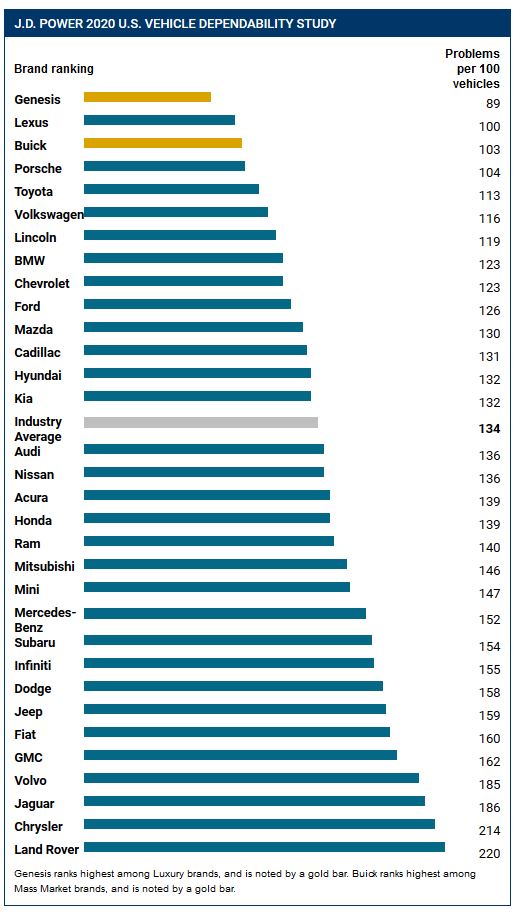
Love is in the air. Maybe it’s the proximity to Valentine’s Day or maybe it’s that owners see dependability of their three-year-old vehicles improving in 2020. According to the J.D. Power 2020 U.S. Vehicle Dependability Study
SM (VDS), released today, overall vehicle dependability improves 1.5% from 2019.
“Despite the increased adoption of complex vehicle technology, dependability continues to improve,” said Dave Sargent, vice president of global automotive at J.D. Power. “There’s no question that three-year-old vehicles today are better built and more dependable than same-age vehicles were in previous years. However, the rapid introduction of technology is putting increased pressure on dependability, so it would not be surprising to see problem levels plateau, or even increase, over the next few years.”
The study, now in its 31st year, measures the number of problems per 100 vehicles (PP100) experienced during the past 12 months by original owners of their three-year-old vehicles. The 2020 study measures problems in model-year 2017 vehicles. A lower score reflects higher quality, and the study covers 177 specific problems grouped into eight major vehicle categories.
Following are key findings of the 2020 study:
- Vehicle dependability improves—but at a slower rate: The industry average in 2020 is 134 PP100, which is an improvement of just 2 PP100 from 2019. (However, in 2019, there was an improvement of 6 PP100 from 2018.) Despite the slowing rate of improvement, 2020 marks automakers’ best performance in the history of the study.
- Dependability gains driven by crossovers and SUVs: Crossovers and SUVs still have slightly more problems than cars, but the gap is narrowing. On average, owners of crossovers/SUVs experience 134 PP100, compared with 127 PP100 by car owners. This 7 PP100 gap has narrowed considerably from 2019. With crossovers/SUVs now accounting for more than 50% of new vehicle sales annually, it is critical that automakers achieve the same level of quality and dependability as for cars.
- In-vehicle technology shows greatest improvement: Audio/Communication/Entertainment/ Navigation (ACEN) is the most improved category (by 2.3 PP100), but still accounts for more problems than any other category in the study. Owners continue to cite problems with voice recognition, Bluetooth® connectivity and navigation systems. “Many owners complain about these systems early in the ownership experience and, three years later, they’re still frustrated with them,” Sargent said. “We’re seeing improvement, but automakers still have a long way to go to before they can declare victory in this area.”
- Most Dependable Model: The Lexus ES is the highest-ranked model in the 2020 study. Its score of 52 PP100 is the best ever recorded in the 31-year history of the study.
- First all-electric model receives an award: The Nissan LEAF is the first all-electric model to receive a segment-level award, for compact car.
Highest-Ranked Brands
Genesis ranks highest in overall vehicle dependability among all brands, with a score of 89 PP100. This is the first year Genesis has been included in the study. Lexus ranks second with a score of 100 PP100 (an improvement of 6 PP100 year over year). Buick (103 PP100) ranks third, Porsche (104 PP100) ranks fourth and Toyota (113 PP100) ranks fifth.
Cadillac shows considerable improvement with a reduction of 35 PP100 from 2019. Other above-average brands with strong improvement include Mazda (reduction of 29 PP100), Lincoln (by 28 PP100), Ford (by 20 PP100), Buick (by 15 PP100) and Volkswagen (by 15 PP100).
Toyota Motor Corporation receives six segment awards for the Lexus ES, Lexus GX, Toyota 4Runner, Toyota Avalon, Toyota Sienna and Toyota Tundra. The Toyota brand receives the highest number of segment awards in the study.
General Motors Company receives five segment awards: for the Buick Encore and Buick Regal, and for the Chevrolet Equinox, Chevrolet Silverado HD and Chevrolet Tahoe.
The 2020 U.S. Vehicle Dependability Study is based on responses from 36,555 original owners of 2017 model-year vehicles after three years of ownership. The study was fielded from July through November 2019.