PREDICT The CHANCES Of Gas Prices DECLINING If DEMOCRATS Win The Mid-Terms? And If So, HOW Would They Do It?
Posted on 10/22/2026 by Agent001
Gas Prices and Midterm Outcomes: What the Data Suggests for Democrats in Control
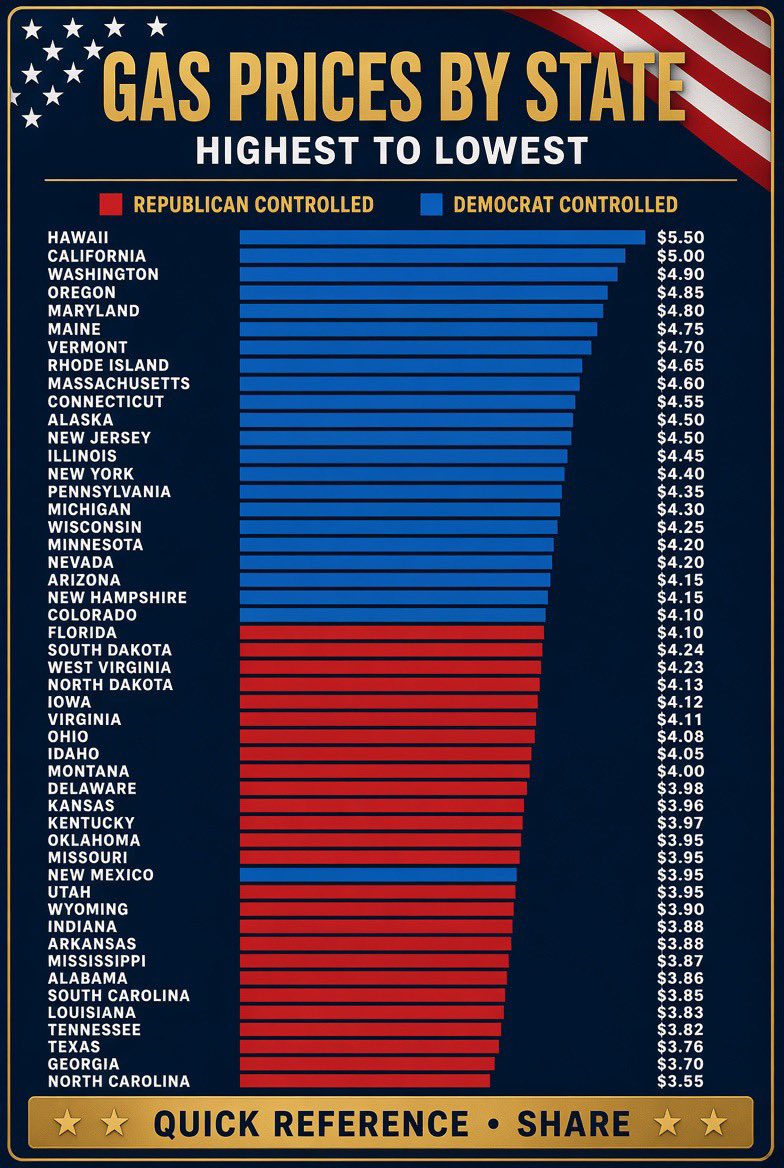
A current ranking of U.S. gas prices by state, ordered highest to lowest and color-coded by party control, shows a clear pattern: the top of the list is dominated by Democrat-controlled states, while the bottom is overwhelmingly Republican-controlled.
Hawaii and California sit at the peak (around $5.50–$5.00 in the chart, higher in recent AAA data), followed by Washington, Oregon, Maryland, and other blue states. By contrast, states like North Carolina ($3.55), Georgia, Texas, and other red states occupy the lowest tiers. National averages hover near $4.27 per gallon as of late October 2026.
This is not a new observation. Analyses from the Institute for Energy Research and others document that unified Democratic-control states (governor plus both legislative chambers) have averaged roughly 55 cents per gallon higher than unified Republican states in 2026, with the gap driven largely by policy.?
State gasoline taxes are the biggest direct lever—about 89 cents of every extra tax dollar reaches the pump—and Democratic-controlled states tend to levy higher ones. Environmental rules, carbon-pricing programs (such as Washington’s Climate Commitment Act, estimated to add 40-plus cents), special fuel formulations, and constraints on refining capacity further widen the difference, especially on the West Coast. Cumulative years of Democratic control since 2001 predict higher prices more strongly than current party labels alone, reflecting accumulated taxes, regulations, and lost refining capacity.
Global factors matter too: crude oil near $100 a barrel amid Strait of Hormuz instability and related conflict has kept prices elevated nationwide, with analysts expecting them to stay above $4 before the November 2026 midterms.
High fuel costs are already a political liability. Yet the state-level pattern is consistent: places that have pursued higher taxes, stricter environmental standards, and limits on fossil-fuel infrastructure systematically show higher pump prices.
If Democrats gain ground in the midterms—taking the House, Senate, or more governorships and legislatures—the historical record offers little reason to expect broad declines. Expanding the same tools (higher fuel taxes, carbon programs, tighter permitting, or mandates that raise refining costs) would more likely add to prices or slow any drop from falling crude. Short-term measures such as temporary tax holidays, subsidies, or price controls have been floated in policy debates, but they do not expand supply and often create distortions or shortages over time. Meaningful, sustained relief would require increasing domestic production and refining capacity while reducing taxes and regulatory friction—policies more commonly associated with the opposite political approach.
Global oil markets and geopolitical events will continue to set the baseline. State and federal policy choices then amplify or dampen the result at the pump, as the chart illustrates.
What are the chances gas prices decline if Democrats win the midterms—and how would they achieve it?
Spies, predict the odds.